Case examples
CES™ can be used to support the interpretation of real assets by combining engineering reasoning, energetic benchmarking, and a synthetic structural condition output.
The case examples shown on this website are intentionally limited extracts. The full CES™ client deliverable is a structured technical report, typically organised into 6 chapters. It covers methodology, declared inputs, energetic contributors, global CES classification, and engineering interpretation. Report length may vary depending on the case.
Shiploader application examples
(for Engineers and technical specialists)
Domain: BULK HANDLING ASSETS
Although both machines may appear structurally acceptable under conventional stress-based assessment, CES™ reveals that the 8000 t/h shiploader (case 1) operates with a much narrower energetic reserve and is significantly closer to a critical fatigue-driven condition.
Case example 1
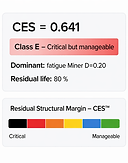
8000 t/h Continuous Shiploader
CES = 0.641 → Class E
(Critical but manageable)
Dominant: fatigue Miner D=0.20
Residual life: 80 %

Case example 2
4500 t/h Continuous Shiploader
CES = 0.502 → Class D (Adequate) Dominant: fatigue Miner D=0.20
Residual life: 80 %


Asset class: Bulk handling assets
Assessment output: CES™ Class E
Key insight:
Fatigue-related reserve consumption
appears structurally significant and
deserves priority attention within the
current asset condition.
Engineering value:
Supports targeted monitoring, maintenance prioritisation and engineering review where structural fatigue may become the leading operational concern.

Asset class: Bulk handling assets
Assessment output: CES™ Class D
Key insight:
Fatigue remains the dominant mechanism,
but within a more manageable overall
structural condition.
Engineering value:
Helps maintain control through structured monitoring and maintenance planning while preserving the current condition margin.

Why CES™ is needed after FEM
CES™ adds a level of interpretation that becomes especially valuable when comparing two shiploaders: it separates the governing energy contributions, shows which machine is consuming a greater share of its structural reserve, estimates the remaining margin available in service, and links the dominant energy pattern to a more appropriate line of action, such as structural modification, maintenance planning, reinforced monitoring or targeted machine improvement.
In this sense, CES™ is not only useful for comparative assessment and maintenance prioritisation, but can also provide forensic engineering value if a premature failure occurs, by helping reconstruct the energetic condition that had developed in the asset before the event.

Pump foundation application example
(for Managers and decision-makers)
Domain: CIVIL STRUCTURES
This case shows how CES™ can also be applied to civil support systems and foundations, translating the structural response into an energetic diagnosis. In this example, the foundation remains in Class A, with seismic/inertial demand identified as the main contributor to the global energy balance.

Centrifugal pump 6 HDX 24A - 2978 rpm
pump weight 5000 kg - rotor weight 202.75 kg
common skid 11.5 x 3.5 x 0.5 m.
Case example 3
Foundation under seismic loading
CES = 0.003 → Class A (Excellent)
Dominant:
seismic / inertial energy (U_seismic = 96.0%)
Asset class: Civil structure / foundation system
Assessment output: CES™ Class A
Key insight:
The foundation remains energetically well within the available safety margin. Seismic/inertial demand is the dominant contributor to the global structural energy balance, while soil–structure compliance plays only a secondary role.
Engineering value:Confirms the high structural resilience of the foundation under the declared loading condition and supports engineering validation of anchorage behaviour, lateral load transfer and seismic response consistency.

From FEM verification to energetic diagnosis of seismic foundation response
A conventional FEM model can confirm stresses, displacements and support reactions in the foundation. CES™ goes one step further: it translates that structural response into an energetic balance, showing how much energy the foundation system is actually absorbing and which physical mechanism is governing the global condition. In this case, the result is not only that the foundation remains well within the available margin, but that the absorbed energy is driven primarily by seismic/inertial action, while the soil–structure compliance remains secondary. This turns a standard verification into a clearer engineering diagnosis, helping the civil engineer immediately recognize where the structural demand is really concentrated.

AOD Converter application example
(for Engineers and technical specialists)
Domain: THERMAL & PROCESS EQUIPMENT
In the AOD case, CES does not treat the converter as a single wall: it uses the refractory layer sequence to reconstruct heat transfer through the lining, estimate interface temperatures and heat flux, and determine the actual thermal demand reaching the steel shell.
Case example 4
AOD Converter
CES = 0.172 ➜ Class B (Very Good)
Dominant:
elastic distortion energy (U_el = 59.9%)
Asset class: Thermal and process equipment
Assessment output: CES™ Class B
Key insight:
Elastic energy remains the dominant contributor, while cyclic and creep-related effects are present but still within a stable overall structural condition.
Engineering value:
Helps interpret combined thermal, cyclic and time-dependent demand in high-temperature process equipment, supporting monitoring and maintenance planning without indicating an immediate need for structural upgrade.

Why CES™ matters for an AOD converter
CES™ gives the customer a clearer understanding of how thermal and structural demand develops across the refractory layers, the shell and the lifting points, while also estimating the remaining structural reserve of the converter. This supports safer operation, more informed maintenance decisions and greater protection of both plant assets and personnel.


Fluid machine application example
(for Managers and decision-makers)
Domain: FLUID MACHINES
In this fluid-machine example, CES shows how cavitation-related flow phenomena may acquire structural meaning, contributing to excitation, local degradation relevance and reduced effective operating margin.
Case example 5
Fluid machine
CES = 0.094 ➜ Class A (Excellent)
Primary Risk Contributor: Fluid Excitation
Asset class: Fluid machines
Assessment output: CES™ Class A
Key insight:
The overall energy demand is well within the safety margins, with fluid-induced excitation representing the dominant contribution to the structural energy balance.
Engineering value:
Confirms the high structural resilience of the design against dynamic fluid loads and supports the validation of operational stability in vibration-sensitive environments.

Why CES™ is needed after FEM
CES™ is needed after FEM because it adds phenomena that are critical in fluid machines but are not captured in standard structural output alone: energy-channel decomposition, fluid-induced excitation, cavitation-related surface effects, residual reserve evaluation and the overall energetic condition of the machine. This provides a more complete basis for machine protection, maintenance planning and operational safeguarding.

Pump flow-rate: 360 m³/h

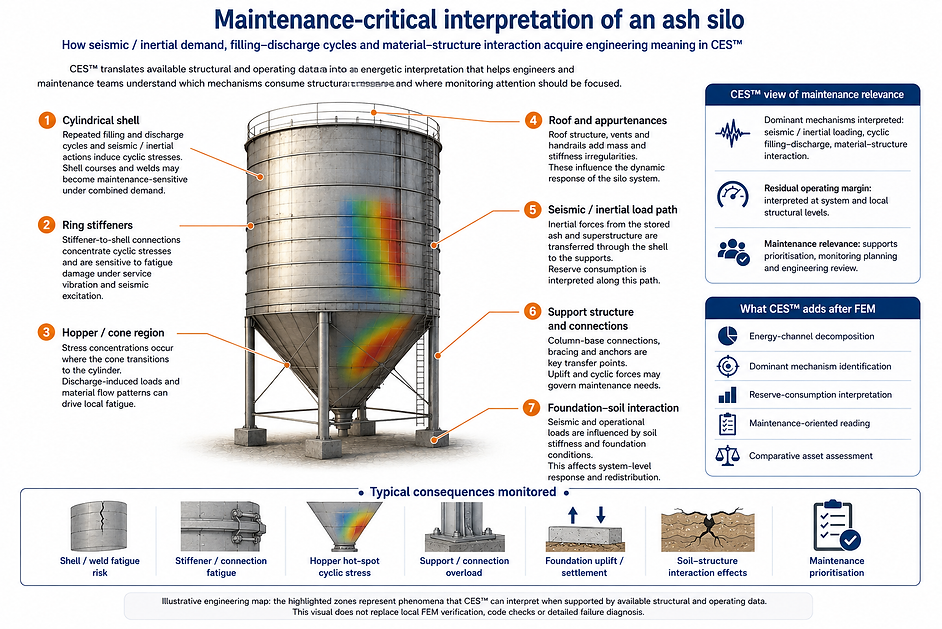
1000 m3 Ash Silo application example
(for Engineers and technical specialists)
Domain: BULK HANDLING ASSETS
How the same silo leads to two different conclusions
This silo is not interpreted by CES™ as a simple civil structure. It is evaluated as a bulk-handling asset, exposed over time to repeated filling and discharge cycles, material flow, impact, abrasion and cyclic structural demand.
Under operating conditions alone, the structural state remains manageable. When seismic demand is added, however, CES™ evaluates the earthquake acting on a structure whose energetic reserve has already been partially consumed by years of service.
The result is a different structural diagnosis. Seismic energy becomes the dominant contribution, but the final outcome is shaped by the combined effect of seismic demand, fatigue, wear, impact and baseline elastic response.
This is where CES™ goes beyond isolated verification: it captures the interaction between operational history and sudden external loading within one unified structural energy balance. Reaching a comparable interpretation with conventional methods would generally require coupling structural FEM with additional flow or process modelling.
Breakdown of total energetic demand
-
Seismic / inertial energy: 1.051e+06 J (67.7%)
-
Cyclic / fatigue energy: 2.775e+05 J (17.9%)
-
Wear / abrasion energy: 1.429e+05 J (9.2%)
-
Impact energy: 4.469e+04 J (2.9%)
-
Elastic baseline energy: 3.725e+04 J (2.4%)

Case example 6
Silo for Ash evaluated in its operating condition
CES = 0.377 ➜ Class C (Good)
Dominant:
fatigue-related cyclic energy (U_cycle = 57.5%)
Asset class: Bulk handling assets
Assessment output: CES™ Class C
Key insight:
The structural condition remains globally good, but cyclic demand is the leading energy driver, with additional contribution from impact and wear mechanisms associated with bulk material handling.
Engineering value:
Helps maintain control through fatigue-focused inspection, structured monitoring and maintenance planning while preserving the current structural margin.


Case example 7
Silo for Ash assessed with seismic loading added
CES = 1.221 ➜ Class F (Unsafe)
Primary Risk Contributor: Seismic / inertial energy
Asset class: Bulk handling assets
Assessment output: CES™ Class F
Key insight:
Seismic demand becomes the dominant energetic mechanism and drives the structure beyond acceptable reserve under the declared conditions.
Engineering value:
Supports rapid identification of critical seismic vulnerability, helping prioritise immediate review, temporary mitigation measures and operational decision-making.
CES™ does not evaluate the silo as new. It evaluates it as operated.
Why CES™ is needed after FEM
CES™ does not interpret the silo as a static structure, but as an operating bulk-handling asset. It evaluates the structure as it actually behaves in service: through repeated filling and discharge cycles, material flow, impact, abrasion, fatigue and seismic demand acting on a reserve that may already have been partially consumed over years of operation. The result is a more realistic structural diagnosis, capable of revealing conditions that conventional verification alone may leave hidden. Very few tools can interpret a silo in this integrated way, and mainstream analysis software generally requires separate FEM, DEM and sometimes CFD workflows to reach a comparable level of understanding. CES™ condenses that operational reality into a unified structural-energy diagnosis, providing the user with a faster, clearer and more decision-oriented view of the asset.
Container RMG (Rail Mounted Gantry) application example
(for Managers and decision-makers)
Domain: CONTAINER HANDLING MACHINES
The value of this case lies in its accessibility: CES™ converts everyday operating data into a structural-energy reading that can support earlier technical judgement, maintenance planning and operational review, even when detailed local FEM data are not yet available.



Case example 8
RMG assessed from decision-level
operating inputs
CES = 0.161 ➜ Class B (Very Good)
Dominant:
dynamic operational energy (U_dyn = 100%)
Asset class: Container handling machines
Assessment output: CES™ Class B
Key insight:
The overall structural energy demand remains well within the available safety margin, with
dynamic operational demand acting as the dominant contributor to the global energy balance.
Engineering value:
Supports early identification of the governing operating mechanism and helps guide monitoring, dynamic review and maintenance planning while preserving the current structural margin.
CES™ works upstream of detailed FEM
This RMG case is particularly significant because it was obtained from decision-level GUI inputs only, without relying on a local FEM hotspot. CES™ uses operating data such as payload, speeds, cycles and service exposure to reconstruct the structural energy demand of the component under evaluation. The outcome is a Class B assessment with dynamic energy clearly dominating the response, showing how CES™ can support early technical judgement even before detailed FEM refinement.

Pressure Vessel application example
(for Managers and decision-makers)
Domain: THERMAL & PROCESS EQUIPMENT
In this pressure-vessel example, CES™ reveals how thermal operating conditions influence structural reserve, showing that constrained expansion and temperature-dependent capacity reduction can become the governing drivers of the energetic state..

Key insight:
The structural condition remains globally good, but thermal demand is the leading energetic mechanism, with constrained expansion and temperature-dependent reserve reduction governing the current response.
Engineering value:
Helps interpret thermal loading in pressure equipment and supports targeted review of thermal gradients, restraint conditions, insulation strategy and operating assumptions while preserving the current structural margin.

Case example 9
Pressure vessel assessed from decision-level operating inputs
CES = 0.363 ➜ Class C (Good)
Dominant:thermal energy (U_th = 100%)
Asset class: Pressure equipment
Assessment output: CES™ Class C
-
Nominal capacity: 123.79 L
-
Design pressure: 1.0000 MPa
-
Test pressure: 1.8500 MPa
-
Design temperature: 180 °C
-
Contained fluid: Steam
From nameplate data to structural insight
The strength of this case lies in accessibility: through the Manager GUI, CES™ can turn basic pressure-vessel nameplate data into a first structural-energy diagnosis, enabling faster maintenance judgement and earlier visibility on the residual reserve of the asset.

Parking structure application example
(for Managers and decision-makers)
Domain: CIVIL STRUCTURES
This case shows the accessibility of CES™ for civil structures: from a limited set of macro-level building and seismic inputs, CES™ reconstructs the energetic response of the parking structure and provides an immediate reading of its residual operating margin.
Case example 10
Parking structure under seismic civil assessment
CES = 0.068 ➜ Class A (Excellent)
Dominant:
dissipative energy (U_diss = 71.4%)
Asset class: Civil structure
Assessment output: CES™ Class A
Key insight:
The parking structure remains energetically well within the available
safety margin, with dissipative response governing the global condition
and seismic demand acting as the secondary energetic contributor.
Engineering value:
Supports rapid interpretation of seismic structural behaviour by showing that, under the declared conditions, the building retains a very large residual margin while clearly identifying how dissipation, seismic demand and soil–structure interaction contribute to the overall response.


From seismic verification to structural-energy diagnosis
CES™ adds an interpretative layer that is particularly valuable for civil structures under seismic loading: it does not stop at confirming that the parking structure remains in a highly favourable overall condition, but shows which physical mechanism is actually governing the absorbed energy. In this case, CES™ reveals that the energetic state is dominated by dissipative response, with seismic demand clearly present and soil–structure compliance remaining secondary, turning a conventional assessment into a clearer and more decision-oriented structural diagnosis.

4500 t/h Bucket Wheel Stacker-Reclaimer application example
(for Engineers and technical specialists)
Domain: BULK HANDLING ASSETS
This case is intentionally extreme, and that is precisely why it is so meaningful.
A bucket wheel stacker-reclaimer is among the most structurally demanding bulk-handling machines in operation: asymmetric, highly cyclic, exposed to pulsating actions and governed by severe fatigue-driving service conditions. In such a machine, a high CES™ value does not automatically mean poor design or imminent collapse. It means that the structure is working in a genuinely demanding operating regime and must be used, inspected and maintained with full awareness of its structural energy consumption.
This is where CES™ becomes especially valuable.
Traditional checks may confirm that the machine satisfies local strength requirements, but CES™ adds a deeper operational interpretation: it highlights how strongly the real duty cycle is consuming structural reserve. In other words, CES™ does not say “this machine fails.” It says: “this machine must be operated properly, monitored carefully, and supported by rigorous structural maintenance and periodic inspections.”
The case is also significant from a professional engineering standpoint because the CES™ bulk workflow allows the user to choose between different fatigue-oriented reference approaches, including DIN-like and Australian-inspired interpretations. This is not a cosmetic option. It reflects the fact that bulk machines may be conceived for different operating realities — coal, iron ore, port terminals, steel plants, or severe mining environments — and that professional assessment must respect those distinctions.
For this reason, the stacker-reclaimer case is not only extreme: it is emblematic.
It shows how CES™ helps engineers move from a simplistic “pass/fail” view to a more mature structural reading: a machine may be viable, but only if its operational severity is understood and managed accordingly.
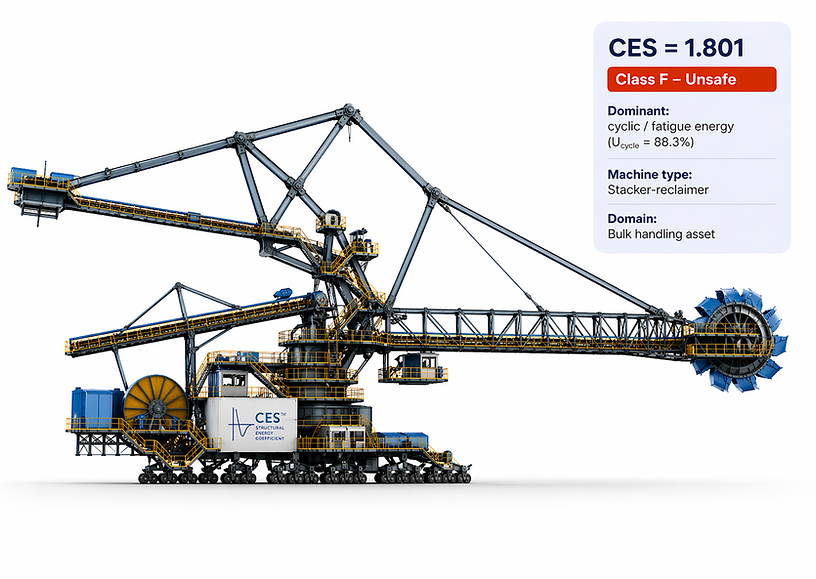

Case example 11
Bucket wheel stacker-reclaimer
CES = 1.801 ➜ Class F (Unsafe)
Dominant:
fatigue / cyclic energy (U_cycle = 88.3%)
Asset class:
Bulk handling asset (stacker-reclaimer)
Assessment output:
CES™ Class F
STA-RE Capacity: 4500 t/h
Key insight:
A high CES™ here does not automatically mean poor design
or imminent collapse. It indicates a structurally severe,
fatigue-driven operating regime that requires disciplined use,
rigorous inspections and maintenance awareness.
Engineering value:
Adds an operational reading beyond pass/fail verification by showing how strongly real service cycles consume structural reserve. Supports fatigue-focused monitoring, maintenance prioritisation and sound engineering judgement.
From fatigue verification to operational structural awareness
CES™ adds an interpretative layer that is particularly valuable for a bucket wheel stacker-reclaimer, where structural severity is driven by very high cycle counts, pulsating actions and fatigue-dominant service. In this case, CES™ shows not that the machine is necessarily poorly designed, but that its structural reserve is being heavily consumed in operation, supporting more rigorous inspection, maintenance planning and disciplined use.

Steel road bridge application example
(for Engineers and technical specialists)
Domain: CIVIL STRUCTURES
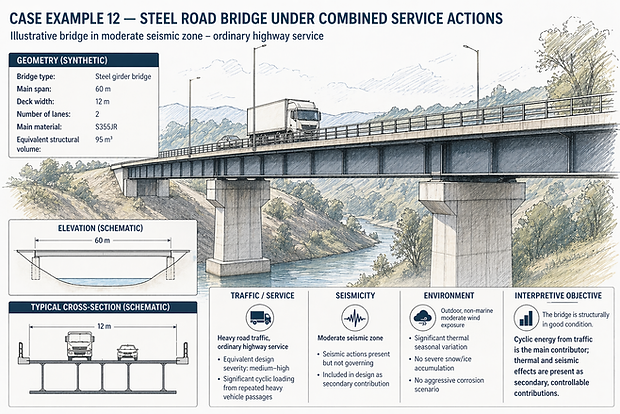
This case shows how CES™ can be applied to bridge structures as long-life civil assets whose structural reserve is progressively consumed under continued service. In this example, the bridge remains in Class C, with dynamic/vibrational demand as the leading energetic contribution, while the broader value of the assessment lies in interpreting the remaining structural margin in a form that can support responsible monitoring, maintenance and long-term safety decisions.

Case example 12
Steel road bridge under combined service actions
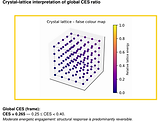
CES = 0.265 → Class C (Good)
Dominant:
Dynamic / vibration energy (U_dyn = 73.2%)
Asset class: Civil structure / steel road bridge
Assessment output: CES™ Class C
Key insight:
The bridge remains in globally good structural condition under the declared service scenario. Dynamic and vibration-related demand is the leading energetic mechanism, while elastic structural response remains significant and seismic contribution is present as a secondary, non-governing effect.
Engineering value:
Helps interpret how combined traffic-induced dynamics, structural vibration and moderate seismic demand interact in a steel bridge, supporting targeted review of dynamic amplification, modal behaviour, damping strategy and service-condition consistency while preserving the current structural margin.
Why this bridge case matters
In a bridge, structural assessment is not only a question of present compliance, but of residual life under continued service. CES™ is particularly meaningful in this context because it translates the combined effect of traffic, dynamic response, thermal variation and seismic input into an energetic reading of the structure’s remaining margin. The value of this approach is not merely to classify the current state, but to support a more responsible interpretation of how much structural reserve is still available and how its consumption should guide monitoring, maintenance, strengthening or eventual replacement decisions.

320 t Overhead Travelling Crane application example
(for Managers and decision-makers)
Domain: LIFTING & CRANES
In this overhead crane case, CES™ translates physical machine data, lifting capacity, travelling motions and wheel–rail interaction into a structural-energy diagnosis. The assessment shows how the crane behaves as an operating lifting system and identifies the dominant energetic mechanism before any detailed local FEM hotspot interpretation is introduced..
Case example 13
Overhead crane assessed from physical reconstruction inputs
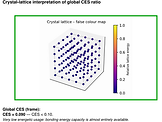
CES = 0.090 → Class A (Excellent)
Dominant:Dynamic / service-motion energy
U_dyn = 100% of the active CES energy balance
Asset class:Lifting & cranes / Overhead crane
Assessment output: CES™ Class A
Key insight:
The overall structural energy demand is very low under
the declared operating conditions, with a large residual
energetic margin still available.
The result is governed by dynamic / service-motion energy.
This means that, in the reconstructed operating scenario,
the most relevant mechanism is not a static resistance issue,
but the operational behaviour of the crane during lifting,
trolley travel, crane travel and wheel–rail interaction.
Engineering value:
CES™ supports an early energetic screening of the overhead crane using available technical reports, physical machine data, motion parameters and reconstructed operating assumptions.
The analysis helps identify the governing operating mechanism and directs attention toward dynamic review, excitation sources, modal proximity, damping measures, acceleration profiles and wheel–rail behaviour before considering generic reinforcement.


From physical reconstruction to energetic awareness
This overhead crane case shows how CES™ can support the assessment of lifting equipment even before a detailed local FEM hotspot analysis is introduced. Starting from physical reconstruction inputs — lifting capacity, travelling motions, acceleration data, structural mass and wheel–rail interaction — CES™ provides a first energetic reading of the crane as an operating system.
The result does not replace EN 13001, FEM verification or Miner fatigue assessment. Its value lies in showing that, under the reconstructed operating conditions, the global structural-energy demand is low and the dominant mechanism is linked to dynamic service-motion effects rather than to a static resistance issue.
This distinction is important: the CES™ stress derived in this case is a distributed energetic equivalent over the selected bridge volume, not a local verification stress at a rail contact, weld, support or load application point. A detailed FEM model may identify higher local stresses, while CES™ explains how much global energetic margin is being used and which physical mechanism is responsible.
In this sense, CES™ works both upstream and downstream of FEM: upstream, it provides fast decision-level screening from physical machine data; downstream, it can become a post-FEM energetic layer, decomposing local stresses and volumes into energy channels that help guide optimisation, inspection priorities and dynamic behaviour review.

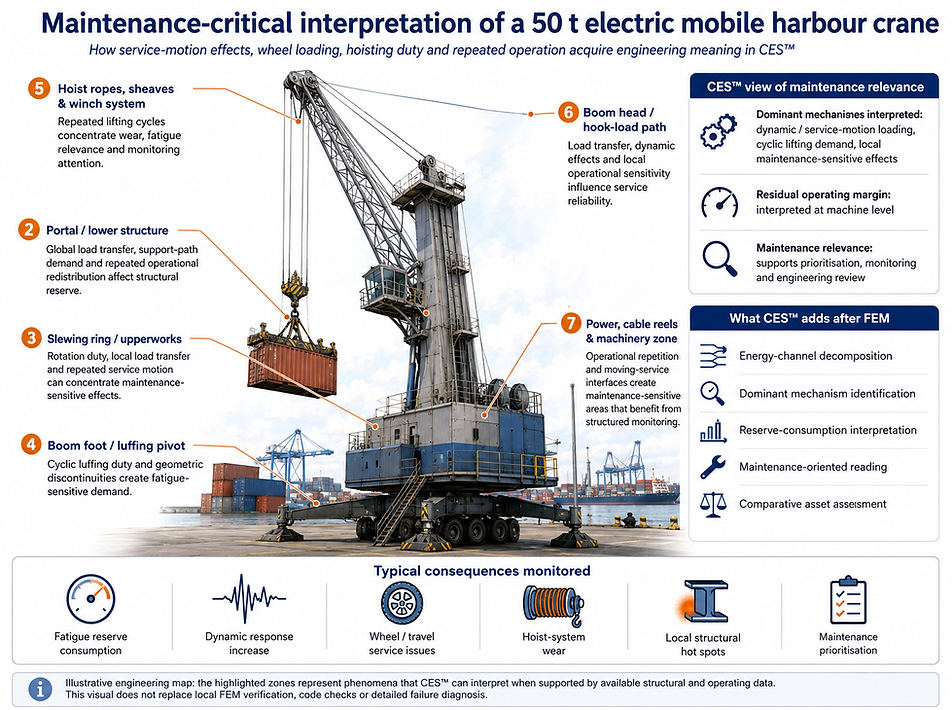
50 t Electric Mobile Harbour Crane application example
(for Managers and decision-makers)
Domain: LIFTING & CRANES
In this electric mobile harbour crane case, CES™ converts declared FEM classification, container-handling data, spreader mass, hoisting speed and travelling motion into a structural-energy diagnosis. The analysis separates the classification-based severity of the crane from the physical reconstruction based on declared kinematics, showing how CES™ can provide an early structural-energy reading even without a detailed FEM hotspot model or complete operational logbook.


Case example 14
50 t Electric Mobile Harbour Crane assessed from physical reconstruction inputs
CES = 0.002 → Class A (Excellent)
Dominant: Dynamic / service-motion energy
U_dyn = 100% of the active CES energy balance
Asset class:Lifting & cranes / Mobile harbour crane
Assessment output: CES™ Class A
Key insight:
The overall structural energy demand is very low under the declared operating conditions, with a very large residual energetic margin still available.
The result is governed by dynamic / service-motion energy. In this case, CES™ does not interpret the full hoisting work as structural damage energy. Instead, it separates the functional lifting work from the portion of motion energy that is transferred to the structure through a controlled structural transfer factor.
This allows the mobile harbour crane to be assessed as an operating port asset, using available manufacturer specification data, spreader configuration, reconstructed structural mass and declared crane motions.
Engineering value:
CES™ supports an early energetic screening of the electric mobile harbour crane even without a detailed FEM hotspot model or complete operational logbook.
The analysis distinguishes between the declared FEM classification envelope and the reconstructed physical service-motion contribution. This helps decision-makers understand whether the crane’s structural severity is driven mainly by its nominal duty class or by its actual operating motions, such as hoisting, crane travel, spreader handling and dynamic service behaviour.

From classification data to physical service-energy screening
CES™ adds value in this mobile harbour crane case because it separates two different engineering readings: the declared FEM classification envelope and the reconstructed physical service-motion demand. The analysis shows that, under the declared operating scenario, the transferred structural energy from hoisting and crane motion remains very low, while the full hoisting work is correctly kept outside the structural damage balance.
This makes CES™ useful as an early screening tool for harbour equipment when complete FEM hotspot data or original operating logbooks are not available. It allows the customer to obtain a transparent first energetic diagnosis from manufacturer data, spreader configuration, estimated structural mass and declared motion parameters, while clearly identifying when a deeper EN 13001, FEM or fatigue reassessment would be required.